
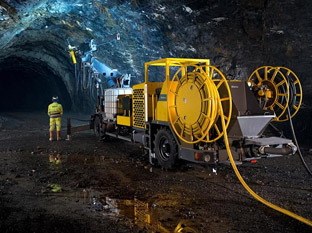
Brazil iron ore DTH drilling places high impact and wear demands on every part of the drill string. This project involved blast-hole construction in an iron ore mining application using high-pressure down-the-hole tools. The objective was to extend bit life while keeping penetration and hole cleaning stable enough to improve the complete drilling cycle.
Project Overview
| Project | Brazil Iron Ore Mining Project |
|---|---|
| Application | Mining blast-hole drilling |
| Tool system | High-pressure DTH hammer, DTH bit and compatible drill string |
| Main objective | Control abrasive wear and improve drilling continuity |
| Recorded result | 35% longer bit life and 28% higher overall construction efficiency |
Drilling Challenge in Abrasive Iron Ore
Iron ore formations can combine high compressive strength with abrasive mineral content. Under these conditions, carbide buttons, the bit face and gauge protection may wear quickly. If the hammer, bit and compressor output are not matched, the operator can also encounter slow penetration, poor cuttings removal, repeated regrinding and unstable hole diameter.
The project therefore needed to be evaluated as a complete system rather than as a single drill-bit replacement. Important selection inputs included the required hole diameter, formation hardness and abrasiveness, compressor pressure and air volume, drill rig rotation capability, drill pipe interface and the wear pattern of the previous tools.
High-Pressure DTH Tool Matching
- A high-pressure DTH hammer was matched to the available air package and production-hole requirement.
- The DTH bit face and carbide-button configuration were selected for hard, abrasive rock.
- Gauge protection and flushing passages were considered to maintain hole size and remove cuttings.
- Drill pipes, adapters and thread connections were checked as one drill string.
- Rotation speed, feed force, lubrication and inspection intervals were treated as part of the operating plan.
The selection principle was to transfer impact energy efficiently at the bit face without applying excessive feed or rotation. Stable flushing was equally important because cuttings left at the bottom of the hole can be crushed repeatedly, increasing wear without producing useful penetration.
Recorded Project Results
According to the supplied project record, the matched high-pressure DTH configuration increased single-bit service life by 35%. Overall construction efficiency improved by 28%. Longer service intervals reduced the frequency of tool changes, while a more stable drilling response supported better production planning for the blast-hole cycle.
These figures reflect this project’s recorded operating conditions. Actual performance depends on formation, hole diameter, air supply, operating parameters and maintenance practice, so results should not be treated as a universal guarantee.
What Mining Contractors Can Learn
The most useful commercial measure is not the purchase price of one bit, but the total cost per drilled meter. Penetration rate, bit life, hammer maintenance, fuel consumption, downtime and tool-change frequency should be reviewed together. A higher-performing combination can deliver lower total cost even when its unit price is not the lowest.
Information Required for a Similar Recommendation
- Rock type, hardness, abrasiveness and representative photos
- Hole diameter, average depth and required hole straightness
- Drill rig model and rotary-head capability
- Compressor pressure and available air volume
- Current hammer, bit shank and drill-pipe thread
- Current penetration rate, service life and wear photographs
Learn how to choose a DTH hammer for hard rock, review our mining drilling solutions, or browse the drilling tool range.
Written by: HLDRILLS Technical Team
Technical review: HLDRILLS Drilling Applications Team
Data note: Results are based on the project information and operating record supplied for this case.